A journey from New Zealand to Norway by two rookies in a 50 year old sailing boat

A journey from New Zealand to Norway by two rookies in a 50 year old sailing boat
Viser innlegg med etiketten New Zealand. Vis alle innlegg

torsdag 28. mai 2009

The headlamp


My Petzl Tikka Plus, my first personal acquaintance with diode techonology. It was bought at «førsteutikken i Näätämö», it was even on sale, i remember the day clearly. It was an impulse purchase, but a good one nonetheless. That headlamp has seen action on four different continents. It has survived military operations (it was anyway camouflage), rock climbing, numerous camping trips, skiing and hunting. Countless books has been read in its light. I've had that headlamp for longer than I've been able to hang on to any girlfriend. It was even handy to have around the boat, cranking out hundreds of hours of light on three AAA batteries.

Now it's at 25 degrees 30.86 minutes S, 177 degrees 01.80 minutes W, about 380 nautical miles south of Fiji. If anyone is going that way and finds it, can you please bring it back? You might need diving equipment, it's about 3000 metres deep there.

It was swept off my head as I was leaning over the side and the jib sheet snapped upwards. «Too bad it wasn't on» I thought as I watched it disappear, «it would have been cool to watch the light sink».

lørdag 16. mai 2009

FIJI!!


The very first survival report: Suva, Fiji


All those of you who had placed your bets on our shipwrecking or giving up already on the first leg: You've lost your money! All those of you who's placed money on us failing miserably at a later stage: you're still in the game!

So we've landed on Fiji. Egil for the second time after getting stuck here on his way from LA, me for the first time. We anchored in Suva harbour in the morning the 13th feeling pretty knackered after 16 days at sea and spending the entire last night tacking back and forth in between some islands. We were trying to get to Suva against a current and wind who had joined forces in trying to convince us of the futility of such an undertaking.
We had a pretty interesting start of the journey. For the first three or four days the wind was blowing good. Excellent sailing wind. If you were going anywhere but from south to north, for instance if you have decided to take your boat from New Zealand to The South Pole. We were not. The whole thing was topped off with a gale the forth night blowing up to 35 knots.


We got out of it allright though, even though that was the worst weather we've sailed in. We were down to our smallest sails in the end. We were so happy when the morning came we celebrated by cutting my hair on the foredeck. Should anyone feel the need for a haircut done in a 30 knot blow, Egil is your guy!


The gale incidentally coincided with the retrieval of our sealegs that up until the third or fourth day had been stowed somewhere were we were unable to locate them. The only time spent below deck those days were pretty much time spent asleep. Food was mostly meals that we had cooked before leaving, anticipating the upcoming misplacement of sealegs. However by the third day the remaining pre-cooked meals were turning greener than our faces, and it was about time to toughen up and deal with life awake below deck and in front of the stove. No more problems from that point on.


After our little gale-experience the winds turned the other way: our way. Too bad they at the same time decided to take some time off. We spent a lot of time in fickle winds, keeping us busy changing sails to try and keep moving in 4-8 knots of wind. We had 5-6 days of several hours spent rolling around in the swell without being able to move. Also towards the end we had a full day, 24 hours straight, without going anywhere (diesel cost $$, wind is free you know). We were therefore pretty amazed when we at day ten out from NZ saw sails in the horizon and raised a dutch yacht (incidentally called «Libertijn») on the VHF. It turned out they had started out from the same place as us, only one and a half day before us, and we were even north of them! They complimented us on making «good speed». Big smiles!


Other than that, nothing much. We've got to use ALL our sails, from storm jib to gennaker. We've spent some time repairing our 50 year old lightwind genoa and other bits and pieces.


Egil had a pod of dolphins keeping him company for hours on one of his nightshifts. Some days out from New Zealand a small bird came out to us. Not a sea-bird, just a little fellow that had probably been blown off shore by the winds. He came to us and rested for some time under our sprayhood, but he was too scared to eat the bread we tried giving him or to stay along for the rest of the trip to Fiji.


The days have gone by leisurely. We have kept the boat moving, eaten, slept, read, enjoyed the scenery (yes, the ocean do have «scenery»!), and let the windwane do the steering for us. Other than steering in and out of Whangarei and Suva respectively, we have helmed for one hour altogether for 16 days... And then, finally; FIJI!!!


..and now we're in Suva. Not the nicest of places, but good enough after two weeks at sea. It's pretty dirty, smelly and worn down, but still charming and friendly. And we get to do our blogging and laundry, but we hope to move on from here shortly. Hopefully in a couple of days. We hope to cruise our way in one- and two day legs up to Lautoka were we are gonna clear out and head over for Vanuatu. Both Lautoka and Suva is on Viti Levu, the Fijian main island. Lautoka on the west coast and Suva in the south.


RUTINER

Dagene våre består stort sett av:
1: Holde båten i gang. Skifte seil eller justere kursen. Vi har et vindror som gjør at vi slipper å styre for hånd hele veien. Vindroret styrer båten relativt etter vinden. Mao. Om vinden dreier dreier vi også og vi må derfor holde litt øye på rorkaren. I tillegg er det en del småjusteringer å gjøre med vindroret, båten må bl.a. være korrekt trimmet for at det i det hele tatt skal fungere. I tillegg kommer litt tilfeldig vedlikehold og rydding, alt etter behov og lyst.
2:Sove. Vi spiser middag sånn ca. Når det blir mørkt, altså i seks-sju tida. Etter dette går en av oss til sengs og sover til den andre vekker han ved midnatt om ikke han trenger hjelp til f.eks. Seilskifte i dårlig vær eller lignende. Midnattsvakta går frem til klokka 0400, da er det vaktskifte igjen, og førstemann legger seg igjen mens den andre går vakt frem til.... den andre våkner. Det blir lyst ca. mellom klokka seks og sju og etter det er det ikke noe problem å holde seg våken, så vi tilstreber å la den som sover få sovet ut mest mulig. Når han omsider våkner er det frokost før morravakta evt. legger seg nedpå litt for å ta igjen en time eller to med søvn, alt etter behov. Om dagen tar vi vaktordninga som det passer, men stort sett er en av oss på dekk. Altså vakt fra: middag til midnatt, midnatt til fire og fire til frokost.
3: Spise: Frokost, lunsj og middag. Når det passer.

4: Fritid. Her inngår det mye lesing og musikklytting. Vi hører også en del på lydbøker, spesielt på nattevakt. Av og til litt styrketrening i form av armhevinger eller situps. Når vi har ligget stille eller gått sakte har det hendt at vi har tatt oss litt svømmetrening rundt båten.

UNDERVEIS


Dag 12 ut fra NZ


Vi har ca. 200 nautiske mil igjen til Fiji nå, et par dagsetapper under gode forhold. Vi har vært på havet i to uker. Det er nesten like lenge siden vi så land sist.

Jeg hadde trodd det skulle bli vanskelig å være så isolert, klaustrofobisk kanskje. Men det har vært uproblematisk. En firetimers nattevakt flyr avgårde mens man hører på musikk og kikker på stjernehimmelen. Ikke noe nordlys her, men melkeveien er en god erstatning og stjerneskuddene raser forbi med en slik frekvens at jeg begynner å slippe opp for ønsker. Jeg går særdeles lyse tider i møte om bare halvparten av stjerneskuddønskene mine går i oppfyllelse.

Jeg har vært på havet før, jeg kan tilogmed erindre og ikke ha sett land på noen kanter før. Forskjellene består i at jeg uten unntak har vært ombord på mye større fartøy og at jeg aldri har vært så langt ute. Jeg har heller aldri sett på havet som noe spesielt vakkert, eller som et stykke natur, men her ute, nå, er det så annerledes. Jeg ser skjønnheten i bølger og masse vann. Langt til havs kan man se været rundt deg ut fra skyene. Man kan se været som treffer en om 7-8 timer nærme seg sakte, og man føler seg i ett med naturen på måter jeg bare sjelden har opplevd langt til fjells før. Jeg har kommet meg over kvalmen og uroen fra de første dagene og nå nyter jeg bare å være underveis.

I 1969 deltok Bernard Moitessier i «Golden Globe», verdens første solo, verden-rundt regatta. Denne regattaen hadde 9 deltakere der bare én fullførte og der en annen ble schisofren og til slutt tok selvmord ved å forlate båten sin midt i Atlanterhavet. Moitessier lå an til å vinne, men etter å ha rundet Kapp Horn bestemte han seg for å fortsette videre verden rundt én gang til fordi han ?trivdes så godt?. Jeg skjønner det nå. Jeg skjønner hva som er tiltrekkende ved å være til havs. Livet her er enkelt. Slitsomt til tider, men enkelt, ekte og liketil.

Vi sjekket ut av New Zealand den 27. april. De første dagene var litt tøffe med mye vind fra feil retning og vi ble tvunget til å gå nesten rett østover. Den tredje natta kom vi ut for en stiv kuling, igjen fra feil side.


Da dette var mer «vær» enn vi noensinne har prøvd å seile i ble det litt interessant «i støytan», men vi gjorde det vi trodde var riktig og kom ut av det i riktig ende og på rett kjøl. Vi feira soloppgangen med å klippe håret mitt på fordekket.

Foruten å tilbinge de første dagene i angst og usikkerhet og med konstante justeringer for stadig økende vinder brukte vi også en del tid på å prøve å finne ut hvor vi hadde stuet sjøbeina våre. Det skulle gå tre-fire dager før de på mystisk vis dukket opp. Frem til da var spising en geskjeft som ble foretatt ut fra nødvendighet mer enn lyst, og mest mulig tid ble tilbragt på dekk. Til tross for dette ble det ofret litt til sjøgudene underveis, men etter de første dagene har ingen av oss hatt problemer.

Vi hadde før vi starta hørt at så lenge vi bare kom oss to-tre dagsetapper fra New Zealand så ville ikke været by på problemer. Dette viste seg å holde stikk på den måten at vi ikke kom ut i mere uvær. Istedet fikk vi andre utfordringer i form av vindstille og for lite vind til å komme oss noen steds. Vi følte ikke at det gikk spesielt fort med tanke på både de første dagene der vi måtte gå østover og de påfølgende vindfattige dagene. Vi var kanskje ikke heller istand pga. manglende erfaring å utnytte forholdene til det maksimale og tenkte med oss selv at «man kan ikke regne med racerfart som førstereisgutter heller». Stor var dermed overraskelsen da vi ti dager ut fra New Zealand for første gang fikk se annet liv enn flygende fisk og ditto fugler; vi så plutselig et par seil i horisonten litt bak oss. Vi kalte dem opp på radioen, vel vitende om at disse nok tilhørte den gruppen av båter som skulle forlate NZ en uke etter oss. Da vi etter et par minutter avsluttet med «Liberty out» og la fra oss radioen kunne vi måpende konstatere at ikke bare kjente disse menneskene båten vår fra Whangarei, de hadde også startet fra samme punkt som oss. Ett og et halvt døgn før oss. Til alt overmål mente de vi hadde «made good speed». Vi takket for det usannsynlige komplimentet.

Tre dager senere var det definitivt slutt på fremdriften. På et døgn karet vi oss 17 nautiske mil nærmere Fiji. Utelukkende på grunn av drift. Hele dagen blåste det for lite til at det var vits å så mye som prøve å seile. Jeg lå utpå kveldinga på toppen av kahytt taket og leste en bok mens sola forberedte seg på å ta kveld. Mens Carl Hamilton tok av med Middle East Airlines til Beirut var jeg såpass oppslukt av handlingen at jeg nesten hørte flyet ta av. Da flyduren fortsatte til tross for at Hamilton for lengst hadde sjekket inn på hotellet i midtøsten begynte jeg å ane uråd og tok meg bryet med å kikke rundt meg. Et par sekunder seinere ropte jeg ned til Egil som puslet rundt i båten under meg at han «får sette over kaffen, vi får besøk!». En større seilbåt kom puslende for motor rett mot oss der vi lå å rullet frem og tilbake i dønningene. De tok en runde rundt oss, lurte på om alt gikk bra og hvor vi skulle, deretter fortsatte de, lenge før kaffen hadde blitt ferdig. Stillehavet begynner å bli folksomt.


La meg her skyte inn et fakta om seilbåter: Når en seilbåt har vind i seilene ?lener? den seg på en måte over på seilene. Dette medfører at båten blir liggende på skeiva, som vi sier nord for plarsirkelen. Dette er litt uvant men man blir da vant med det. En bieffekt er at båten ligger stabilt til en side og ikke ruller nevneverdig i bølgene og dønningene.

La meg så skyte inn et fakta om havet: Ute på det åpne havet er det bestandig dønninger.

Den observante leser vil fra det ovenstående kunne dedusere seg fram til at når det ikke er vind vil seilbåten på ingen måte forholde seg stabilt liggende på skeiva. Snarere vil tilværelsen ombord i den stilleliggende seilbåt kunne oppfattes som mistenkelig lik en permanent busstur på taket av en dobbeldekker buss på vei opp og ned Trollstigen i 90 km/t. Slik tilbrakte vi altså hele gårsdagen da vi fikk besøk.

I går natt var forøvrig den første natta jeg ikke trengte å kle på meg mer enn T-skjorte da jeg gikk på vakt. Vi kommer nærmere nå! Fleecejakka blir snart putta i en plastpose og stuet lengst bort i det mest utilgjengelige skapet.


torsdag 9. april 2009

COLD


I get out from under my duvet and spare blankets. I put on my T-shirt and shorts. I continue with my woollen beanie, my hoodie and woollen socks. Still cold I pull the hood up over my head. I then fire up the gas stove to make us some breakfast. Egil is still asleep. I stand for a second enjoying the heat from the little blue flame. Morning mist is floating on the river outside the porthole. Winter is coming to New Zealand. Time to leave now.


tirsdag 7. april 2009

STOLEN GOODS

We've left West Park Marina four weeks ago. Since Egil's arrival we have filled our time with boat maintenance, boat modifying, general getting-to-know-the-boat and sailing the boat. Actually both of them; we have learned a lot from sailing our dinghy. Now we are anchored up in Hobson Bay right outside of Auckland. Since we have no clue as to what we're doing we're anchored with two CQR anchors and 40 metres of chain. In three metres of water. But its sweet to get out here to the free zone, that close to Auckland centrum. Just to be safe. We soon run out of gas. I take the gas bottle to a petrol station for a refill. Since I'm on foot I ask the attendants if I can leave the bottle and pick it up later as I'm going into town. Seven hours later I return to find the gas bottle gone. Apparantly some guy in a BMW pulled up and said I had sent him to pick up the bottle.

Buy a new gas bottle. We're finally taking some time off from the boat and we're going whitewater kayaking a weekend. Egil gets his chance to see some more of beautiful New Zealand. We're letting out another 10 metres of chain (just to be safe) and paddle our dinghy ashore and leave it under a small bridge. Same place we have left it every day last week. Upon our late return from a great weekend we find our precious dinghy gone!
It's a little past midnight and we are pretty tired. The weekend has been full of physical- and social activities. We have met a lot of interesting people, and especially this old salt that called himself “Captain Morgan” has left the two of us a little worse for wear. But alas, there is no way of returning to the boat, so we spend a miserable
night in the car James has generously lent us so we could get ourselves and the gear home. Off to Warehouse to buy a 99$ childrens play dinghy (Toyworld didn't have any). Our beautiful 10 years old yellow Metzeler dinghy later mysteriously reappears. Someone has tied the deflated version of it to a post on the other side of the bridge. We retrieve the sad remains of our object of great attention and countless hours of repairs for the last month.
It
is now clearly FUBAR, or “possibly not repairable within the limitations of ordinary people”. Only one of the pontoons inflate somewhat, the other one has a 10 centimetre cut in it and the floor
leak fast.

mandag 6. april 2009

WHANGAREI TUNING

Spendingspree and things for free
We came here to Whangarei because a) it's a bit further north in New Zealand and therefore «on the way» for us. b) Lots of people have told us to go here because it is apparently really easy to get «everything» done here, and it's supposed to be plenty of other cruisers you can gather information from.
As we had no dinghy we were forced to check into a marina. There we were quickly dubbed «The Orange Glow» due to our bright orange safety-netting that we've been (very gratefully) sponsored by the Auckland City Council. Thank you Council!

Our slightly more fancy neighbours took well to their new young Norwegian, scruffy and inexperienced cruising colleagues. We had heard lots about the generousity of the cruising community, but what we experienced in that marina was way beyond what we expected! We were showered with freebies from the other boats. As they passed us on their way to the trashbins they always stopped by to ask if we wanted their old boomcover, hatch funnell, solar panel mounts (aka random bits of aluminium tubing), WiFi antenna, their old cockpit cushions, new (!) sailbag etc etc. We got so many more or less useful bits and pieces we couldn't believe it! I guess their generousity might have something to do with our hopelessly inexperienced and dirt-poor appearance.


We arrived with a super-long To-Do list. Included on this list were new batteries (oh my God, the prices!), new solar panel mounts, fixing half a dozen electrical issues, sorting out how and where to stow stuff, fill our diesel-tanks, fill our water-tanks, get a proper solar panel mount and doing The Engine.

This last task ended up taking us almost a week and costing us about 550 $NZ (about et par tusen norske krones). It seemed that the deeper we dug into Good Old Yanmar 2GM20(F), the more stuff we needed to fix, sort out, repair, replace or buy. However now she's running like a dream, and has apparantly accepted all her new parts and fluids.
All the while we were doing boat maintenance we got heaps of information, tips, hints, radio frequencies, software and general help from the other cruisers. They even lent us plenty of tools to do the jobs so we didn't have to struggle with our own (which are limited to three adjustable spanners, 5 screwdrivers (4 philips and one gigantic flat), a multitool, a hacksaw, a hammer and the world's biggest axe (don't ask why, we can't give you an intelligent answer.))
We also took advantage of the vicinity of a supermarket to buy and stow away an amazing amount of supplies.

However yesterday, after 10 days in the marina, our «new» dinghy finally arrived in the mail, and there was no more (at least not a whole lot more) reason for us to stay at the marina. We had a last shower for a while, dropped our moorings and floated down the river to anchor up with the other slumdog cruisers, where we belong.
We are at present discussing whether to stay here until our necessary work is done and the weather breaks, or to carry on to Opua, even further norh, to do the same thing there. We are also disussing whether to abandon our original plan of going to New Caledonia first, or set sail for a a slightly longer first leg, and go to Fiji instead.
All for now, peace out.

SAILING OFF

We had stayed too long in Auckland. Losing our dinghy air pump was that drop. At least my gypsy-nomadic self started to vibrate with eager to leave for something new. A few days later we set sail for Whangarei, with a plan to stop over at Great Barrier Island. That means going north. Homewards. It sure felt good, and as we raised our foresail I even I felt confident about leaving and sailing and anchoring and all that. Luckily, after counting up our total of sailing days since I came down here, things got a little more real. 6 daytrips in and out of our Marina, two succsessfull atempts to anchor up, in well marked anchor/mooring areas and some bedtime sail litterature seemed to be all our experience. And yes, thinking of it, that boat still felt enourmus to handle, but yet so little when reaching the occean. In any case, with small, cozy butterflies stuck somewhere in our stomaches, we slowly headed upwind towards the open sea and Great Barrier Island.

It sure was a fine day, but slow winds turned into no wind. So when night fell, we could still see Auckland in the far horizon as we anchored up in a calm and beautiful bay at one of the many islands along the coast. A real slow-mo day, but that being our first night outside auckland, and with memorable pancakes for dinner things felt great.


We went of that morning with really nice winds, clear blue sky and perfect sailing conditions. Even though we were slowed down by a calm period, just as the winds turned around coming from east, we were now coming up past our destinations neighbouring island; Little Great Barrier. The sun was setting and a large pod of dolphins came up alongside our boat. It was our welcome surprise before letting of the anchor in one of many spectacular bays of this island.

That night the winds shifted again, and we got some waves in during night. This resulted in some paranoic dreaming and sleepwalking, but nothing more than usual.

So far everything had been going smooth. I was at a high and could not think of any better way to travel. At least it's getting close to driving a moped.

Earlybirds and breakfast at 6.30. Sails up at 7, heading for Whangarei. Our plan was simple; enjoy winds, basic sunbathing, testing of different sail combinations and reach Whangarei at sunset.

Again we got stuck in a no-wind period at mid day. This one lasted on for hours, and we drifted around trying out all we had of spinnakers and sail configurations, but there was no wind.

As it was getting darker we realized Whangarei was out of todays reach. We fired our good old Yanmar 18 HP and bubbled on for one of the nearby Islands. Night was coming fast and the steep sea bottom around the island made it impossible to anchor as the winds picked up again. We decided that faith had set us out facing our first night-sailing experience. The winds picked up even more and we were doing 6 knots and closing in rapidly. One surprise oiltanker, some extra large waves when entering more shallow waters, a little fumbling in the dark trying to see the red and green lights of the narrow approach to Whangarei, pluss one or two now forgotten issues more, and we were lowering anchor in a quiet little bay, just a couple of miles from our final destination, just as the clock struck midnight..

Had a peacfull night with no outbirsts of paranoia and motored in to Whangarei the next morning, all the way up this idiotically long and narrow river.

THE PRINCIPLES OF SURFACE-SUPPLIED DIVING / HULL INSPECTION


You need:

- A certified surface supplied diver, preferably with navy experience
- A snorkel
- A diving mask
- Some metres of garden hose
- An airpump (complete with musculous pump machine)
- Half a roll of insulation tape (preferably 3M super 88)


Use the tape to join all the pieces together, let simmer for about 45 minutes, find a hull to inspect, turn off speeding propellers and sonars, now dive!

LAST TRIP OF THE DINGHY

A week has gone by and we're about to leave Auckland when we decide to get rid of the Warehouse dinghy. We row it ashore along with the Old Yellow Wonder and a pump for the latter. We then dispose of the new one the only way we can think of: we take it back to The Warehouse and get our money back. After having said goodbye to some friends we make it back to our trusty bridge and dinghy hiding place.
Upon arriving back to our sad old Metzeler dinghy we are (not very) surprised to find that someone has bothered to steal the pump while leaving the dinghy (now chained to a post) and the drybags. Laughing in disbelief we start blowing up the one remaining pontoon using only our mouths. A little while later we have fashioned ourself a raft using our drybags, the dingy and some rope. It is leaking in half a dozen places, but it floats and should be able to take us the 6-700 metres out to our boat. We have stripped down to our shorts such as to keep the wet gear to a minimum should the thing sink.
At first things look good; the craft is manouverable and “fast”. It is even pretty dry. However soon after The Point of No Return I, being in the back realise that the freeboard is decreasing. We are soon down to about 10 cm which means that every stroke Egil does up front fills our construction up a little more. Which in turn means we are shipping a little more water with every stroke. Which in turn means we are riding a little lower in the water. Which in turn means we manouver a little worse. Which in turn means we are slower. I think to myself that there is no way we will reach “home” this way, and envision us drifting into the Hauraki Gulf. Not a very pleasant place to be drifting around at one in the morning in a leaking makeshift raft with no lights.
The raft soon becomes agonizingly slow and nigh on impossible to steer. For every three strokes we take I have to brace two strokes at the opposite side and we are moving at about 0,1 knot with the current sweeping us laterally away from our boat. We realise we need a change of tactics.
The current has swept us sideways leaving our own boat an impossible goal, especially as our muscles are on fire with the constant effort the last 30-40 minutes. We do however have a yacht on a neighbouring mooring. It is quite a flashy 50 foot racer, with heaps of electronics in the mast and a nice paintjob. Quite the opposite of our boat in other words. More important than the physical characteristics of our neighbour is his location: he is slightly closer to shore and to the side where the current has been taking us. Add to this that we know for a fact that no one is aboard, the decision to make an unscheduled visit is easy.
Some more minutes of constant effort later and we land at our neighbour's stern. Had we missed we would have drifted to sea. Good thing we didn't.
We take advantage of the roomy foredeck to rebuild our craft, and soon we're off again. The same scenario repeats itself, only this time we're so much closer to home. Ten minutes later we're slapping each other's backs in our own cockpit. We snap some pictures and go to bed. We're ready to leave Auckland.

Next morning as we raise the anchor to leave we see the owner of the neighbouring yacht board his boat. They walk around and get ready for a sail, obviously not suspecting their two scruffy nighbours of having helped themselves to a tour of their boat during the night. We wave to them and turn our backs both to unsuspecting neighbours and to Auckland.

RENDEZ VOUS

Egil:
I had just finished my little pre-adventure; my moped trip from LA to Buenos Aires (see mopeddagboken.blogspot.com), and was now more than ready for that big adventure. I left Buenos Aires with my packings, and with a money-sprinkling stopover in LA, I headed towards New Zealand where Øyvind, supposedly was waiting me with our boat. I had never seen the damn thing, except from Øyvinds facebook pictures, and felt like a christmas morning child as my plane set off for a Fiji stopover.


Oyvind:
Family finally sent home after a christmas/new years visit to New Zealand I started cleaning the boat before the Arrival of the Co-Owner. Priority one; stop that leak in the floor that lately had provided us with up-to-date test samples of the quality of the local sea-water.

I had reached both my goals for the previous year; I had passed all my papers at the university and had summited on Mt. Cook as a part of a greater plan of making my year more about fun and less about studies. I was more than ready for the boat, Egil and me to leave and let the adventure begin. I had lived here in the marina for more than half a year, reading all I could about sailing and wanted to get on with it.


Egil:
“You cant leave Fiji without a return ticket from New Zealand”. I tried to check in for my last destination after a little tasteof the humid and beautiful surroundings of the airport, but it seemed I had a problem. No return ticket, no papers of boat ownership, nothing really. Had to post a electronical telegram to Øyvind in search for help, and 10 hours, 10 swearwords and 10 white slices of bread with honey later I had proven my unlikely ownership of a yacht, located in Auckland city. Øyvind had managed to arrange some papers stating nothing really, but they were papers. In any case I had my last inflight meal as I spotted yet another sail boat from my window seat. I really didnt know what the hell I was getting myself into here. The only thing I did know as I stepped onto New Zealand soil was that I owned something floating worth 50 000 of my Norwegian krones.


Øyvind:
First time at the airport: No Egil. I have misread the arrival date. Second time at the airport: Still no Egil. I didn't check my email. If I did I would have found five different emails from Egil stating five possible arrival times. Hectic digitial communication to follow.

Third time: Finally the guy has been able to coax someone into letting him into the country. He's even quite quick through customs. Funny how efficiently you travel when your combined two year's worth of luggage can be carried in two tax-free shopping bags. One is even a Lacoste. Egil is showing some class.


Egil:
Åja, den karn! A classical Norwegian salute from somone who haven't seen eachother in a long time, and who will spend the next two years together on 20 square meters. We drove down to the privileged West Park Marina and I got to see that enormous pile of fiberglass. Damn that boat is big. My new home. I stuffed my plastic bags into a locker, and there it was. I had moved in, the adventure could begin.

PESSBLAUT FROM NEW ZEALAND TO NORWAY

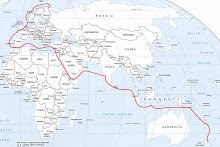
This blog is all about Egil and Øyvind's sailing trip that will hopefully see them go from New Zealand to Kirkenes in northern Norway. The trip is planned to start sometime in April 2009 and finish around august 2010. Later rather than sooner.
The teams previous sailing experience is limited to a number of daytrips that can easily be counted on one hand. That is if the hand has seen a bit of rough use. For instance in combination with chainsaws or other finger decimating machinery.

If the crew is inexperienced The Ship is definitely not! «Liberty» is turning 50 this year and is one of the first fibreglass boats ever made. Hopefully she'll not retire herself for another couple of years.
The blog will mostly be posted in English so our non-scando friends can follow it. Yes, we are thinking of you guys. Both of you.
However there might be the odd post in Norwegian. These will most often have contents of special Norwegian interest that might be better addressed in Norwegian. Alternatively we just don't want you non-Norwegians to understand when we're gossiping about you. However, don't despair: We'll soon grow tired of it and start posting in English again, so stay with us!
Also we of course don't have internet while at sea (well, we could, but that cost money and anything that cannot be paid for in services, seashells or homemade alcohol is not included in our budget.) So posting may be irregular, though we might type stuff up while at sea to post it when we reach land and can access the World Wide Web yet again. In other words; things might be quiet for a while, only to explode in a sudden avalance of blogging.
The «Pessblaut» name is a north Norwegian term meaning being soaking wet, or, more literally; having pissed one's pants. Both not unlikely to happen to the guys during the trip. One of the things will quite likely be a problem of somewhat permanent character, rather than an accidental occurance. Which one it will be is anyone's guess. Depends on the weather I assume. Especially in light of the aforementioned sailing experience, or lack thereof.
So: Stay with us and cheer on us. Pray for us not to sink, run aground, run out of money, have a run-in with any authorities, get the runs, get sick, get tired of cruising, get saltwater allergy, get pirated, eaten by cannibals or navigate wrong and end up in Tahitit where we might take local brides and grow old, fat and sunburnt. Because all these things would stop us from entertaining you on the «Pessblaut» blog.
Peace out.